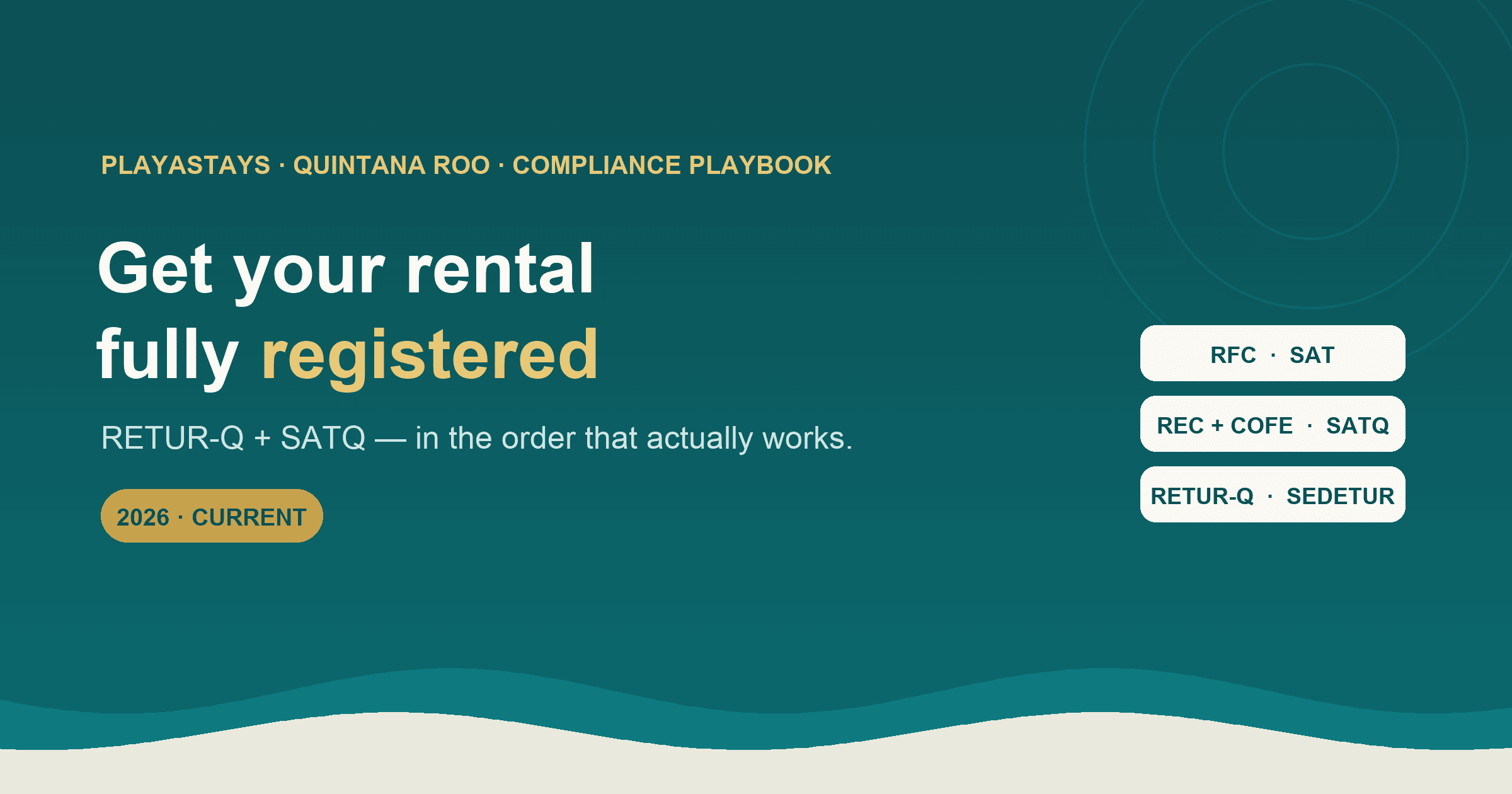
If you rent a property short-term in Quintana Roo, you now have to register it — and the platforms are enforcing it. As of late 2025, Airbnb and Booking began requiring a Quintana Roo tourism-registry number to keep listings active. But “register your rental” actually means two separate tracks, run by two different state agencies, done in a specific order — and one of them (the COFE) just changed at the end of 2025. Most guides cover one track and miss the other. Here’s the whole map, current for 2026.
Two separate tracks — both required
This is the thing almost everyone gets wrong. Quintana Roo compliance is two parallel obligations with two different agencies, and doing one doesn’t cover the other:

- The tax track — SATQ (the state tax authority): your state taxpayer registration (REC), your state fiscal certificate (COFE), and the lodging tax (ISH).
- The tourism track — SEDETUR (the state tourism ministry): the state tourism registry (RETUR-Q, housed in the SITUR-Q system).
Different agencies, different purpose — you need both. (The tax side is where your federal taxes get paid; if you want the full ISR/IVA/ISH picture, see our breakdown of Mexican tax on rental income.)
The order that actually works
These steps unlock each other. Do them out of sequence and you’ll get turned away — the federal RFC’s tax certificate is a required input for the state registrations, which in turn feed the tourism registry.

Step 1 — RFC (federal)
Your federal tax ID from SAT comes first, because its Constancia de Situación Fiscal is required to register for the state steps. And here’s the part owners miss: you don’t need Mexican residency to get one — there’s a dedicated path for residents abroad. We cover it in how to get a Mexican RFC as a non-resident.
Step 2 — REC (state taxpayer roll)
The Registro Estatal de Contribuyentes is Quintana Roo’s own taxpayer registry, run by SATQ. Any host liable for the lodging tax must be on it. It’s the base layer for everything else on the state side, and it doesn’t require annual renewal — you just keep your details current.
Step 3 — COFE (the rule that just changed)
This is the 2026 update most articles haven’t caught. By Decreto 192, published 16 December 2025, Quintana Roo replaced the old “Licencia de Funcionamiento SATQ” with the COFE — Constancia de Obligaciones Fiscales Estatales. Key points:
- It’s issued per property/establishment — a multi-property owner needs one for each.
- Obtained online through the SATQ portal; reported as free.
- It’s annual — valid through December 31 and renewed in the first two months (Jan–Feb) of the following year.
- For the 2026 transition, holders of the old licence were directed to obtain their COFE in Jan–Feb 2026, with penalties for non-compliance from 1 July 2026.
Because this decree is brand-new, confirm the current COFE process and any fee directly on the SATQ portal before you rely on dates.
Step 4 — RETUR-Q (tourism registry)
The RETUR-Q (Registro Estatal de Turismo), housed in the SITUR-Q system and run by SEDETUR, is the state tourism registry. The Ley de Turismo reform published 5 March 2024 made registration mandatory for vacation-rental hosts and platforms alike. What to know:
- It’s done per property, online, and free.
- Platforms now require your RETUR-Q certificate number to keep a listing active — this is the enforcement that started biting hosts in late 2025.
- Typical documents per property: your operating certificate (now the COFE), the SAT tax certificate, ID, proof of address, deed or lease, civil-liability insurance, and photos of safety equipment (first-aid kit, fire extinguisher, smoke/gas detectors).
- The certificate carries a multi-year validity and is renewed before expiry — confirm the exact window in the current SEDETUR call.
Register at the official portals: sedetur.qroo.gob.mx/returq and siturq.gob.mx.
Step 5 — the monthly lodging tax (ISH)
With everything registered, the ongoing obligation is the ISH: 6% for an entire-home rental (5% general). If you book through a platform, it withholds and remits the ISH for you in Quintana Roo. If you take direct bookings, you remit it yourself in monthly payments due by the 10th of the following month.
Renewals at a glance
- RFC / REC: no annual renewal — keep your information current.
- COFE: annual — renew in Jan–Feb, per property.
- RETUR-Q: multi-year validity — renew before expiry (confirm the window).
- ISH: monthly — by the 10th, if you take direct bookings.
Frequently asked questions
Is RETUR-Q really mandatory, or just recommended?
Mandatory. The Ley de Turismo reform (5 March 2024) requires vacation-rental hosts and platforms to register, and platforms now require the certificate number to keep listings active.
Isn’t SATQ registration the same as RETUR-Q?
No. SATQ (REC, COFE, ISH) is the state tax track; RETUR-Q is the SEDETUR tourism track. They’re separate agencies and both are required.
What happened to the “Licencia de Funcionamiento”?
Decreto 192 (16 December 2025) replaced it with the COFE (Constancia de Obligaciones Fiscales Estatales), issued per property and renewed each Jan–Feb.
I own several units — do I register each one?
Yes. Both the COFE and the RETUR-Q registration are done per property/establishment, so each unit needs its own.
Do I need residency or a Mexican RFC to start?
You need an RFC (it feeds the state steps), but not residency — a non-resident can obtain one. You cannot complete the state registrations without the RFC’s tax certificate.
Want this handled for you?
This is exactly the runaround PlayaStays exists to remove. We get owners through all five steps — RFC, REC, COFE, RETUR-Q and the monthly ISH — and keep the renewals on track, per property. If you own (or are buying) a rental in Quintana Roo, get in touch.
Sources
• SATQ — REC & COFE (Constancia de Obligaciones Fiscales Estatales; Decreto 192, POE 16-Dec-2025) — satq.qroo.gob.mx
• SEDETUR — RETUR-Q / SITUR-Q — sedetur.qroo.gob.mx/returq · siturq.gob.mx
• Ley de Turismo del Estado de Quintana Roo (reform POE 5-Mar-2024, Arts. 4 & 52 Nonies) — congresoqroo.gob.mx
• ISH — Ley del Impuesto al Hospedaje, Decreto 030 (5% / 6%) — satq.qroo.gob.mx
Disclaimer
This guide is for general information only and is based on publicly available 2026 sources, including very recent changes (Decreto 192, December 2025) that are still settling. Always verify current requirements, fees, and deadlines directly on the official SATQ and SEDETUR portals and confirm your situation with a qualified Mexican contador or attorney.
Find out what your property could earn with PlayaStays
Free revenue estimate. Based on real market data from our managed portfolio.
Get My Free Estimate →