If you are thinking about moving to Playa del Carmen with kids, the biggest mistake is treating it like one big decision. It is really a bundle of decisions — where you live, where your kids go to school, how much structure versus flexibility you want, whether you want a softer landing or a more local experience, and how much convenience, security, and walkability matter to your family.
That is why the families who tend to do this well usually do not jump blindly. They rent first, tour schools, test neighborhoods of Playa del Carmen, and let daily life guide the next move.
This guide is built around the questions families usually ask early:
- best family-friendly neighborhoods
- good bilingual schools
- realistic monthly costs
- healthcare and private insurance
- safest areas for families
- long-term rentals
- internet reliability for remote work
The short version: Playa del Carmen can work very well for families, but usually works best for people who want some mix of warm weather, outdoor living, bilingual exposure, easier access to the beach and regional travel, and a more flexible daily rhythm. The tradeoff is that some systems feel less standardized than in the U.S. or Canada, and your quality of life will depend heavily on choosing the right neighborhood and school.

1Best family-friendly neighborhoods in Playa del Carmen
There is no single best area for every family. The right fit depends on whether you prioritize security, school access, quiet, walkability, beach access, value, or space. But in practical terms, a few areas come up again and again.
Playacar
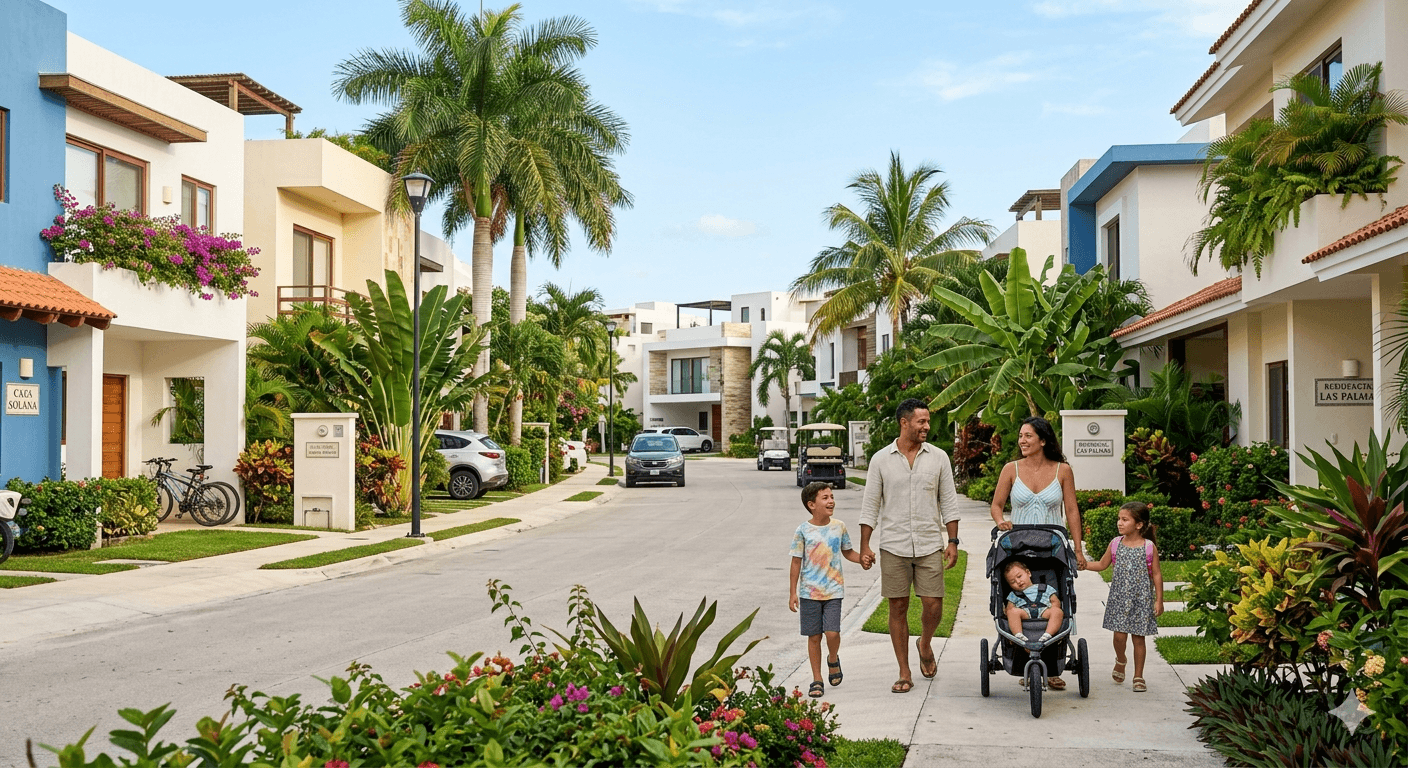
Playacar remains the clearest “default family recommendation” in Playa del Carmen. It is gated, greener, calmer, more established, and more obviously residential than the tourist core. For many families, especially with school-age kids, it offers one of the easiest daily rhythms in town:
- more room to walk or bike
- less nightlife spillover
- stronger sense of separation from the tourist flow
- and a generally more stable family feel
Best for: families who want the least-friction landing, especially if safety, calm, and structure matter more than being in the middle of town.
Tradeoff: it is usually pricier, less spontaneous, and less walkable to the busiest parts of Playa.
El Cielo and Selvamar
These north-side residential communities deserve to be part of the family conversation more often. They appeal to families who want:
- newer homes and buildings
- more space
- pools, parks, and common areas
- a more suburban-style residential feel
- and often better value than core Playacar
Selvamar in particular often gets praise for its green space, amenities, and family vibe.
Best for: families who want newer housing stock, more room, and a more residential, secure-feeling environment.
Tradeoff: daily life is more car-dependent, and you give up some walkability and spontaneity.
Zazil-Há, Coco Beach, and quieter Gonzalo Guerrero pockets
For families who care more about walkability, beach access, cafés, and a more integrated city feel, these areas can work very well. They tend to appeal to families who want:
- beach access without being too isolated
- easier daily errands on foot
- a little more local flavor
- and less dependence on a car, at least in the beginning
Best for: families who want to feel connected to everyday Playa life and still avoid the loudest tourist intensity.
Tradeoff: it is less insulated than Playacar, and building-by-building variation matters much more.
Ejidal and other value-oriented areas
For more budget-conscious families who prioritize space over proximity, Ejidal and similar areas can enter the conversation. These areas can offer stronger value, larger living footprints, and a more local day-to-day experience. But they are usually not the easiest “soft landing” option for families arriving without much local knowledge.
Best for: families optimizing for value and space.
Tradeoff: more adaptation required, less polish, and less of the “easy arrival” feeling many relocating families want at first.

2Safest areas for families
This question is understandable, but it is also one of the least useful when answered too broadly. In Playa del Carmen, “safe” is less about one citywide label and more about neighborhood feel, building management, lighting, traffic and street activity, how residential the area is, and how predictable your day-to-day routine feels there.
In practical terms, the places families often find easiest are the ones with:
- controlled access or stronger building security
- calmer streets
- less nightlife spillover
- more obvious residential identity
- and fewer transient, tourist-heavy patterns
That is a big reason Playacar gets recommended so often. The appeal is not just “security” in the abstract. It is that the environment tends to feel more stable and family-oriented.
A better question than “what is the safest area?” is:
- Would my partner feel comfortable here with the kids?
- Would weekday mornings here feel easy or stressful?
- Does the building itself feel well run?
- Does this area feel residential or transient?
- How does it feel at school-run hours and again at night?
Those questions usually lead to better decisions than broad safety labels.
3Good bilingual schools for kids
This is one of the most important parts of the whole move. A lot of families can make Playa work if the school fit is right. If the school fit is wrong, almost everything else starts feeling harder.

Schools worth looking at
- Britt Academy — a bilingual international option that appeals to families looking for a more international-facing environment, with bilingual support and a more globally oriented presentation.
- Maple Bear Playa del Carmen — a newer Canadian-style bilingual option that may be especially appealing for families who like a Canadian educational framework.
- Colegio Inglés — often one of the most frequently discussed options among expat parents when they want a stronger bilingual balance and a more structured school feel.
- Colegio San Gabriel — also commonly mentioned in family and expat conversations, especially by families looking at the Playacar side of town. Worth visiting in person and asking detailed questions rather than relying on reputation alone.
- El Papalote — a good school to know if you are interested in a more progressive or alternative educational feel.
- K’iin Beh — not the standard first expat answer, but worth knowing about as part of the wider bilingual education landscape.
A more useful way to think about schools
The “best school” is usually not the one with the most polished marketing. It is the one that fits your child’s personality, your family’s language goals, how long you expect to stay, and how much structure versus flexibility your child thrives in.
What to ask when touring
Tour multiple schools and ask:
- What is the real English/Spanish split?
- How many international families do you currently serve?
- How do you support children who are stronger in English than Spanish?
- What does the first semester transition usually look like?
- How does parent communication actually work?
- What is the daily drop-off and pickup reality?
That last one matters more than people think.
Tuition reality
For families planning seriously, it helps to think in monthly terms. A lot of stronger bilingual or international-style options often land somewhere around MXN 6,000–12,000+ per month per child, depending on the school, grade level, enrollment fees, and extras. That is one reason school is one of the biggest budget drivers in the whole move.
4Realistic monthly living costs for a family
This is where people tend to get either unrealistically optimistic or strangely dramatic. The honest answer is that Playa del Carmen can still be cheaper than many U.S. and Canadian cities, but it is not automatically “cheap” if you want a better neighborhood, strong internet, private school, private healthcare, consistent AC use, and a more comfortable expat-family lifestyle.

A more realistic rent framework
For long-term family rentals, a more practical way to think about rent is:
- roughly MXN 18,000–25,000 outside prime areas or in more value-oriented neighborhoods
- roughly MXN 25,000–45,000+ in nicer, more family-friendly, or gated areas
Real prices vary widely by neighborhood, building quality, furnishings, lease length, and how well the property is managed.
Comfortable family budget reality
For many expat-style family lifestyles, a comfortable real-life monthly budget often lands somewhere around MXN 60,000–100,000+, depending heavily on rent, school, car or transport, insurance, groceries and imported-goods habits, and AC and utilities.
That does not mean every family needs to spend that much. It means that once you combine better housing, school, healthcare, and convenience, the total can climb faster than many newcomers expect.
The big budget drivers
The things that usually change the math the most are:
- rent
- school
- car / transport
- insurance
- groceries and imported-goods habits
- AC use and utilities
If you adapt more to local spending patterns, the budget can stay lower. If you keep a more North American convenience profile, costs move up quickly. (Our companion guide on how utilities actually work here goes deep on the AC + CFE side of that math.)
5Healthcare and private insurance
This is the section most relocating families underweight until they need it. Mexico has a real two-tier system — private hospitals and clinics that work cleanly with private insurance, and a public system you can join even as a foreigner. The right answer depends on your budget, your age, and how comfortable you are with Spanish-only intake when something goes wrong.

Hospitals in Playa del Carmen + Cancun
The hospital you’d actually use for a non-trivial issue is closer than people expect — but the best hospitals in the region are in Cancun, an hour north. The realistic family map:
- Hospiten Riviera Maya (Playa del Carmen) — Spanish hospital chain, full bilingual staff, accepts most major Mexican and international policies on direct-bill. The default for urgent-but-not-critical issues in Playa.
- Costamed (Playa del Carmen + Cozumel) — local chain, generally lower prices than Hospiten, less English support. Good for routine care, baby check-ups, GP visits, dental.
- Hospital Galenia (Cancun) — the most equipped private hospital in the region. Joint Commission International accredited. Where most families plan for serious or complex care — cardiac, oncology, complicated pediatrics, anything requiring specialists.
- Amerimed (Cancun + Cozumel) — tourist-oriented private hospital, fluent English, used a lot for travel-insurance cases. Decent middle-ground option.
- Hospital General de Playa del Carmen (IMSS, public) — free emergency care, longer waits, Spanish-only. Worth knowing exists for genuine emergencies if you’re uninsured.
Mexican private health insurance carriers
If you’re cutting ties from Canada (or the US) and need real coverage in Mexico, you’re looking at gastos médicos mayores — major medical expenses. These are the local Mexican carriers most expat families actually use. All of them are written under Mexican regulation (CNSF), denominated in MXN or USD, and pay claims directly to participating hospitals:
- GNP (Plan Premier / Mediplus) — the largest Mexican carrier, broadest hospital network including Hospiten and Galenia. Probably the safest first quote if you don’t know where to start. Annual premium for a family of four (parents 35-45, two kids): roughly $45,000–$90,000 MXN depending on plan tier and deductible.
- AXA Mexico (Plan Versatil) — strong network, good for families who travel back to the US/Canada occasionally (international upgrade riders available). Mid-priced.
- MetLife México (Plan Esencial / Plus / Premier) — the carrier most US-cross-border families use because they coordinate well with US claims if you keep some US presence. Pricier.
- Plan Seguro — mid-size carrier, popular with English-speaking expat families because their concierge desk handles claims in English. Good middle ground — not the biggest, not the cheapest.
- Allianz Mexico — solid mid-tier option. Decent for families who already have Allianz from another country.
- Mapfre — Spanish-Mexican carrier, often slightly cheaper than GNP/AXA for comparable coverage. Network is thinner in Quintana Roo — verify Hospiten and Galenia are in-network before signing.
- Inbursa (Salud Plus) — Carlos Slim’s group, generally lower premiums, network strongest in central Mexico. Cheaper but check QR network depth.
- Atlas Seguros — local carrier, often the most affordable for healthy younger families. Smaller network. Read the exclusions carefully.
Of these, families we work with most often end up at GNP or Plan Seguro because of network breadth and the bilingual claims handling. AXA is a close third for cross-border families.
The IMSS option (public + voluntary for foreigners)
If you have temporary or permanent residency, you can voluntarily enroll in IMSS — the Mexican public health system — on an annual basis. Cost in 2026 is roughly $8,000–$13,000 MXN per person per year depending on age. That gets you access to IMSS hospitals (the public Hospital General de Playa del Carmen, larger IMSS hospitals in Cancun), prescriptions, surgery, the works.
The catch: long waits for non-emergency procedures, Spanish-only intake, mixed quality depending on which facility, and a 1-year waiting period for some conditions when you first enroll. Most expat families we know carry private insurance as primary and IMSS as a backstop — private for everyday care, IMSS for catastrophic costs that exceed private policy limits.
What to actually evaluate when comparing policies
The cheap-looking quote is almost never the right one. The fields that matter:
- Suma asegurada (annual coverage cap) — aim for at least $30,000,000 MXN (~$1.5M USD). Anything under $10M is risky for a serious illness.
- Deducible (deductible) — ranges from $5,000 to $50,000+ MXN. Higher deductible = lower premium. A family with healthy adults usually picks $20,000–$30,000 MXN.
- Coaseguro (coinsurance) — usually 10% after deductible, capped at $50,000–$100,000 MXN per year.
- Red de hospitales (hospital network) — verify Hospiten Riviera Maya and Hospital Galenia are both in-network before signing. This is the single thing most agents skip explaining.
- Pre-existencias (pre-existing conditions) — Mexican carriers usually exclude pre-existing conditions for 1–2 years. Disclose everything truthfully at signup — undisclosed conditions are the #1 cause of denied claims.
- Age caps — some carriers cap new enrollments at age 65 or 70. If parents are older relocating with you, get them enrolled before that ceiling.
- Direct billing vs reimbursement — direct-bill (pago directo) hospitals charge the insurer, you pay copay. Reimbursement means you pay up front and file. Stick to direct-bill networks for serious things.
How to actually get quotes
The fastest path is to find a bilingual independent agent (corredor de seguros) in Playa or Cancun who represents multiple carriers — they can quote GNP, AXA, and Plan Seguro side by side for the same family profile. Avoid signing through a single-carrier agent on the first conversation; you want comparison. A family of four typically gets 3–4 viable quotes within a week, with annual premiums ranging from $35,000 to $120,000 MXN depending on deductible, coverage cap, and whether US coverage is included.
Most expat-focused agents in Quintana Roo speak English and will email proposals in both languages. We can introduce you to two we’ve worked with if it helps — just reach out.
6Long-term rentals

For most families, renting first is still the smarter move. Even if you think you may buy later, a long-term rental gives you time to learn your actual neighborhood preference, school commute reality, building quality, AC performance, noise level, internet reliability, and whether you really want walkability or more space.
The best family-rental filter is not just “is this pretty?”
It is:
- would weekday mornings here be easy?
- how long is school drop-off?
- is the building well run?
- is the AC good?
- does the internet actually work?
- will this area still feel comfortable after the novelty wears off?
That is a much better long-term test.
7Internet reliability for remote work
If one or both parents work remotely, internet cannot be an afterthought. The good news is that fiber internet is widely available in many modern buildings, and strong speeds are common in the right setups.

The more honest local reality is that internet quality is still heavily building-specific. So the right questions are:
- Which provider is installed?
- Has anyone worked full-time from this exact unit?
- What speeds are they actually getting?
- What happens during outages?
- What is the backup plan?
And yes, it is smart to have a backup plan: a mobile hotspot, backup data, or a coworking fallback.
8Transportation for families
This is one of the most commonly underestimated pieces of family life in Playa.
If you live in Playacar, El Cielo, Selvamar, or other more residential outer areas, many families eventually want either a car, a regular driver arrangement, or a more deliberate transportation system than “we’ll just figure it out.” That is especially true once you layer together school runs, groceries, doctor visits, activities, beach days, and weather.
Families in more walkable zones like Zazil-Há or Gonzalo Guerrero can often get away with less car dependence, but even then, many still use a mix of:
- walking
- taxis
- rideshare
- and occasional car rentals
Uber and DiDi can be useful, especially in more central areas, but they tend to feel less seamless farther out or during peak times.
A simple practical rule: the more you optimize for space and quiet, the more likely transportation becomes part of the family setup.
9Residency and legal stay
Families planning longer stays should think about immigration status early, even if the first move is still a trial period. If your move is more than a long vacation, residency starts mattering for things like school enrollment, longer-term rental planning, banking, and day-to-day legal stability.
Temporary residency is often the first major step families consider, but the exact rules, paperwork, fees, and financial-solvency requirements can shift over time.
A lot of families still begin with a trial period or soft landing before formalizing the longer-term plan, which is often a smart way to reduce pressure.
10Seasonality, weather, and real-life rhythm
Families also need to understand the seasonal rhythm. Summer and early fall are hotter, more humid, and overlap with rainy season and hurricane season. That does not mean daily life becomes chaotic, but it does affect outdoor routines, AC use, utility costs, and how the climate feels over time.
Hurricane season runs roughly June through November. Direct hits on Playa del Carmen are relatively uncommon, but the season still matters because it affects humidity, rain, and preparedness mindset.
Families who do well in Playa usually like outdoor life enough that the climate feels more like a feature than a burden, but it helps to be honest about what Caribbean family life actually feels like in August, not just in January.
11Community and social integration
This is one of the most underrated parts of a successful family move.
Families who thrive in Playa usually do not just find a house. They find a rhythm — school community, other parents, neighborhood routines, beach or park habits, trusted service providers, and some social structure outside their own home.
That can come from:
- school events
- parent WhatsApp groups
- neighborhood common areas
- local family activities
- or simply being in an area where other families are visible in normal daily life
This is another reason neighborhood and school matter so much. They shape not just logistics, but belonging.
12Who Playa del Carmen is a good fit for
Playa del Carmen can be a great family fit if you want:
- more sunlight and outdoor life
- beach access as part of normal life
- bilingual exposure for kids
- regional travel convenience
- a more flexible pace
- and a lifestyle where Caribbean living matters more than perfect standardization
It tends to suit families better when they are at least somewhat comfortable with:
- Spanish exposure
- learning gradually
- adapting to local rhythm
- and giving up a little predictability in exchange for lifestyle
It is probably a harder fit if your family strongly prefers ultra-predictable systems, zero friction, highly suburban North American routines, and very low tolerance for ambiguity in services, schools, or logistics.
The bottom line
If you are seriously considering moving to Playa del Carmen with a family, the smartest path is usually not asking “Is Playa good for families?” It is asking:
- Which neighborhood would make our weekdays easiest?
- Which school would help our kids feel stable?
- What budget gives us a comfortable real life here?
- What healthcare setup would make us feel secure?
- Can this exact rental support our work, school, and family rhythm?
That is how you move from fantasy to reality. And that is a good thing. Because the families who tend to do best here are usually not the ones chasing paradise. They are the ones building a daily life that actually works.
Have you moved to Playa del Carmen with kids? What surprised you most?
Frequently asked questions
Is Playa del Carmen safe for families?
Safety in Playa del Carmen is more about neighborhood feel, building management, and how residential the area is than any citywide label. Families typically find areas with controlled access, calmer streets, less nightlife spillover, and stronger residential identity — like Playacar, El Cielo, and Selvamar — easiest to settle into. The better question is not “is it safe?” but “would weekday mornings here feel easy, and would my partner feel comfortable here with the kids?”
What are the best bilingual schools in Playa del Carmen?
Schools families regularly look at include Britt Academy, Maple Bear Playa del Carmen, Colegio Inglés, Colegio San Gabriel, El Papalote, and K’iin Beh. The “best” school is rarely the one with the most polished marketing — it’s the one that fits your child’s personality, your family’s language goals, how long you plan to stay, and how much structure your child thrives in. Tour multiple schools, ask about real English/Spanish splits, and pay attention to drop-off logistics.
How much does it cost for a family to live in Playa del Carmen per month?
For an expat-style family lifestyle, a comfortable real-world monthly budget often lands somewhere around MXN 60,000–100,000+, depending heavily on rent, school, transportation, insurance, and utility habits. Long-term family rentals typically run MXN 18,000–25,000 in value-oriented areas and MXN 25,000–45,000+ in nicer, gated, or family-friendly neighborhoods. The biggest budget drivers are rent, private school, car or transport, insurance, imported-goods habits, and AC use.
Should we rent first or buy when moving to Playa del Carmen with kids?
For almost every family, renting first is the smarter move — even if you eventually plan to buy. A long-term rental of 6 to 12 months gives you time to test neighborhood preference, school commute reality, building quality, AC performance, internet reliability, and whether you really want walkability or more space. Many families start in Playacar or El Cielo and then decide later whether to stay, switch areas, or buy.
Is internet reliable enough for remote work in Playa del Carmen?
Fiber internet is widely available in many modern buildings, and strong speeds are common — but quality is heavily building-specific. Don’t ask whether Playa has internet; ask whether the exact unit you’re considering has been used for full-time remote work, which provider is installed, what speeds people are actually getting, and what the outage backup plan is. A mobile hotspot, backup data, or a coworking fallback is smart insurance.
What’s the best neighborhood in Playa del Carmen for families with school-age kids?
For most families with school-age kids, the lowest-friction option is Playacar, followed by newer gated communities like El Cielo or Selvamar. Families who prioritize walkability and beach access often trial Zazil-Há, Coco Beach, or quieter Gonzalo Guerrero pockets first. A common pattern: rent in Playacar or El Cielo for the first 6 to 12 months, then re-evaluate once you know your school, your daily rhythm, and what you actually want long-term.
Which Mexican health insurance company is best for families relocating to Playa del Carmen?
For most expat families relocating long-term, GNP (Plan Premier or Mediplus) and Plan Seguro are the two that come up most often in real conversations — GNP for the broadest hospital network (including Hospiten Riviera Maya and Hospital Galenia in Cancun), Plan Seguro for bilingual claims handling. AXA Plan Versatil is a close third, especially for families who travel back to the US/Canada regularly and want an international rider. Annual premiums for a family of four (parents 35–45 + two kids) typically run $45,000–$90,000 MXN depending on deductible and coverage cap. Whichever carrier you pick, the single most important thing to verify before signing is that both Hospiten Riviera Maya and Hospital Galenia are in-network — if not, your plan can’t handle the worst-case scenario.
Can foreigners enroll in IMSS (Mexico’s public health system)?
Yes — with temporary or permanent residency, you can voluntarily enroll in IMSS on an annual basis. Cost in 2026 is roughly $8,000–$13,000 MXN per person per year, age-dependent. That gives access to IMSS hospitals (the Hospital General de Playa del Carmen locally, larger IMSS facilities in Cancun), prescriptions, surgery, and ongoing care. The trade-offs are real: long waits for non-emergency procedures, Spanish-only intake, mixed quality across facilities, and a 1-year waiting period for some pre-existing conditions. Most expat families we know carry private insurance as primary and IMSS as a backstop for catastrophic costs — not a primary plan, but a worthwhile second layer for $50–100/month per family.
Where do families in Playa del Carmen actually go for emergencies?
The practical pattern most long-term families settle on: routine care and minor emergencies at Hospiten Riviera Maya or Costamed in Playa del Carmen, anything serious at Hospital Galenia in Cancun (about an hour’s drive north). Hospiten is the default for urgent-but-not-critical issues — fully bilingual, accepts direct billing from most major Mexican insurers, well-equipped for everyday emergencies. Costamed is cheaper and good for routine care but less English support. For anything requiring specialists — cardiac, oncology, complicated pediatrics, major surgery — Galenia is the regional gold standard (Joint Commission International accredited). Amerimed in Cancun is a decent middle option. Worth driving past Hospiten once when you first arrive so the route is familiar before you ever need it under stress.
Find out what your property could earn with PlayaStays
Free revenue estimate. Based on real market data from our managed portfolio.
Get My Free Estimate →